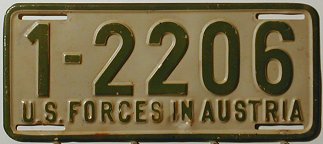
Please note that although I am Austrian, you will not find any current, valid Austrian license plates in my collection. The reason is simple: That would be illegal under Austrian law, and it would be only a matter of time until I got caught if I had any. I only have historic plates, prototypes, and oddballs.
| Historic plates |
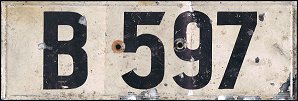 |
1906-1919 front plate. B = Niederösterreich (Lower Austria)
License plates were introduced in the Austro-Hungarian Empire in 1906. They were owner provided. A one letter province or city code was followed by a serial number from 1 to 999. For higher numbers the thousands were denoted in Roman numerals. |
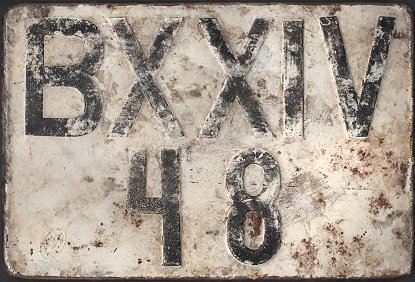 |
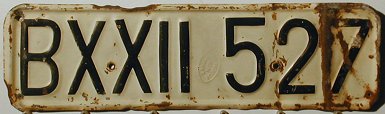
1919-1930 plates. B = Niederösterreich (Lower Austria)
The numbering system of the monarchy was continued in the Republic of Austria, but plates became authority issued and embossed. On these two plates there is an embossed oval seal of the Lower Austria provincial government.
Top: front motorcycle plate, two of which were mounted facing to the side; no rear plates were used.
Bottom: rear car plate. Rear plates were always in two lines. |
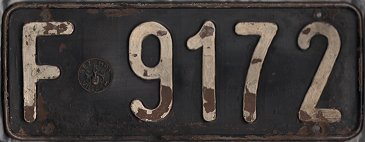 |
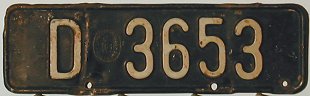
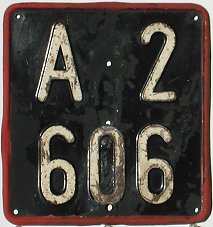
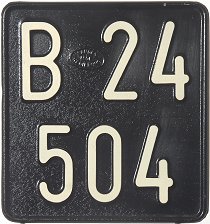
1930-1939 plates.
With more and more vehicle registrations, the roman numbers of the previous system became too long. So a new system with only arabic numbers was introduced. Also the plate colors were reversed. Serial numbers were up to 5 digits, with the thousands being a district code. Four digit numbers did not have a 1000s separator on one line plates.
Top: front motorcycle plate. D = Salzburg.
Two such plates were mounted facing to the side. After the letter there is a large embossed seal of the Salzburg provincial government.
Center: rear motorcycle plates. A = Wien (Vienna), B = Niederösterreich.
On the Vienna plate, the red border signifies that the plate is from a small motorcycle. After the letter there is a large embossed seal of the Vienna police, and the Niederösterreich provincial government respectively.
Bottom Plate: rear car plate. F = Kärnten.
After the letter there is an embossed seal of the Villach district authority. |
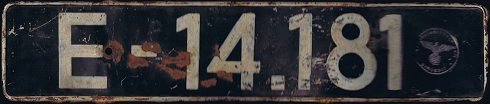 |
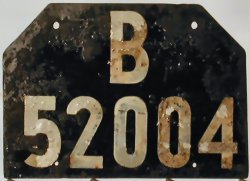
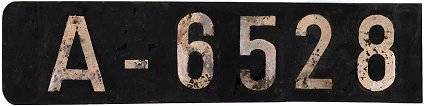
1938-1939 transitional hybrid type plates.
B = Niederösterreich
A = Wien (Vienna)
E = Tirol
After Austria was annected by Germany in March 1938, the Austrian license plate system was at first retained. Plates issued before by Austrian authorities remained valid. Newly issued plates were in the Austrian system, but made according to German rules: The owner had to provide them, either embossed or painted, and the authority only stamped them. These plates had to be white on black, but could be in either Austrian or German layout. The pictured plates are in German style, but the Tirol plate kept the Austrian tradition of a 1000s divider.
In May 1939 white plates in the German system were introduced.
The seal on the Tirol plate reads "Bezirkshauptmannschaft Kitzbühel". |
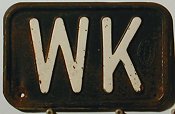 |
1937-1938 additional plate for trucks carrying a company's own goods up to 100 km. WK = Werksverkehr. To the right, there is an embossed oval seal from the Vienna police. |
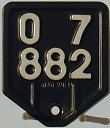
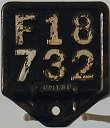 |
Pre-1938 Vienna bicycle plates. These plates were issued in pairs and mounted on both sides of the front wheel. A one letter district code was followed by up to five numerals. O = Ottakring, F = Floridsdorf. |
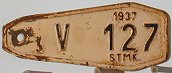
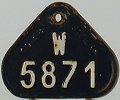 |
Bicycle plates from Steiermark (Styria) province for 1937 and 1938. |
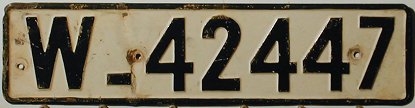 |
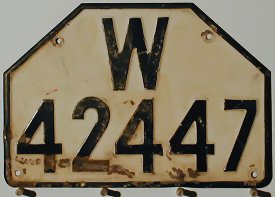
1939-1945 series pair. During that time, Austria was a part of Germany and used plates from the pre-1945 German system. W = Vienna (Wien). |
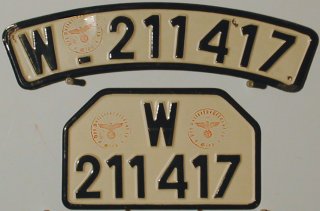 |
1939-1945 series motorcycle triplet. During that time, Austria was a part of Germany and used plates from the pre-1945 German system. W = Vienna (Wien). The front plate consists of two plates rivetted back to back. The seal reads "Der Polizeipräsident in Wien". |
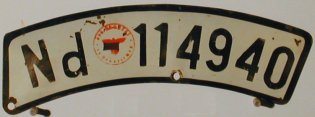 |
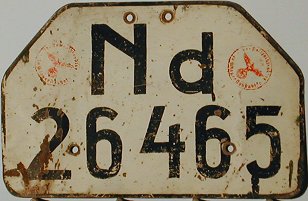
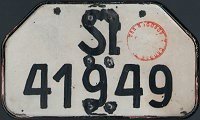
1939-1945 series plates. During that time, Austria was a part of Germany and used plates from the pre-1945 German system. Nd = Niederdonau (Lower Danube, because in that time, the province name Lower Austria was not used).
Upper plate: Rear car plate. The seal reads "Der Polizeidirektor in Wiener Neustadt".
Lower plate: front motorcycle plate. The seal reads "Der Landrat in Neunkirchen". The plate is both-sided, the photo shows the nicer side. |
 |
1939-1945 series rear motorcycle plate. During that time, Austria was a part of Germany and used plates from the pre-1945 German system. St = Steiermark. The seal reads "Der Landrat in Leoben". |
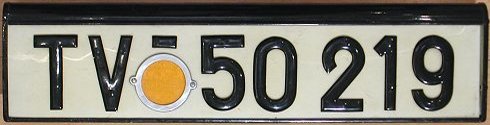 |
1939-1945 series plate. During that time, Austria was a part of Germany and used plates from the pre-1945 German system. TV = Tirol and Vorarlberg. This is a rare self-illuminated plate. For more details, see this plate's special page. |
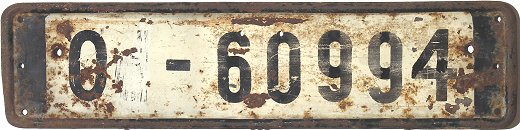 |
1939-1947 series plate. Used before and after 1945. O = Oberösterreich (Upper Austria).
In the American Zone (which included Oberösterreich south of the Danube), German plates continued to be valid until 1947. However, because Oberdonau was named back to Oberösterreich, the letters Od were changed to O. This was simply done by removing the letter d from existing plates. |
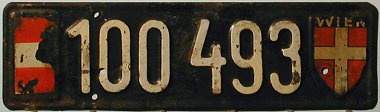 |
1945-1947 series plate. WIEN = Vienna. These plates were only issued in the Soviet occupied zone (Eastern part of Vienna, Lower Austria, Burgenland and Upper Austria north of the Danube) and all of Vienna. |
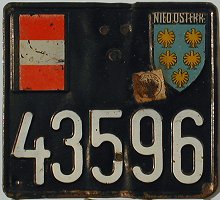 |
1945-1947 series motorcycle plate. NIED.ÖSTERR. = Niederösterreich (Lower Austria). These plates were only issued in the Soviet occupied zone (Eastern part of Vienna, Lower Austria, Burgenland and Upper Austria north of the Danube) and all of Vienna.
Note that this plate has a sticker "Gerichtlich gepfändet" (court impounded) on it. I was told the plate was on a Harley Davidson, whose owner went bankrupt. The bike was then impounded by the court, and the clerk put such a sticker on the plate as well. |
| Prototypes |
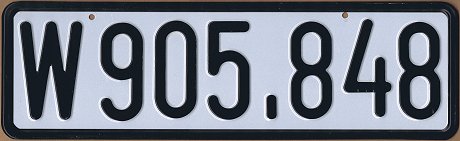 |
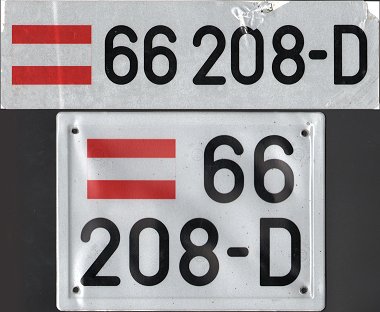
In the 1980s plans started to introduce reflective plates. For this purpose then current style plates in reversed colors were made and tested on non-public roads to see how legible they are and how speed cameras can cope with them. This is such a test plate, which shows evidence that it was mounted on a vehicle. The number is impossible, Vienna never reached the 900.000 series. |
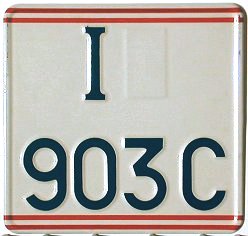 |
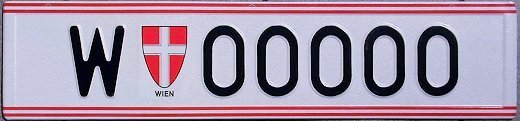
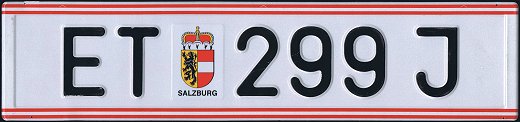
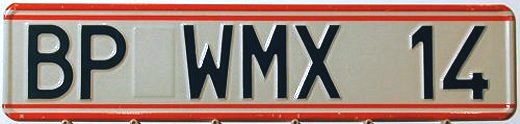
In 1989 it was decided to not only change the plate color to white, but also to introduce a new numbering format and to adopt the European size standard of 520 x 120 mm for one line front and rear plates. The previous rear plates were 140 mm high and did not really fit into the plate area of some newer car types.
Initially the font used on these two prototypes was to be introduced, but people found it ugly and a protest movement started. In the end a new font very similar to that on the black plates was created. The sticker with the coat-of-arms was not applied on my plates, but you can see the slightly raised rectangle provided for it.
BP = Police (Bundespolizei). Real police plates have only digits as serial numbers.
I = Innsbruck. This is actually a valid combination. |
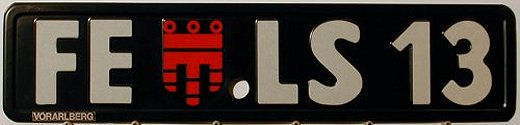 |
This is another prototype, designed by the late artist Friedensreich Hundertwasser. He was against switching from black to white plates, but acknowledged the usefulness of reflective plates. So he created black plates with very thick reflective white characters. This design was never seriously considered by the authorities. FE = Feldkirch |
| Oddballs |
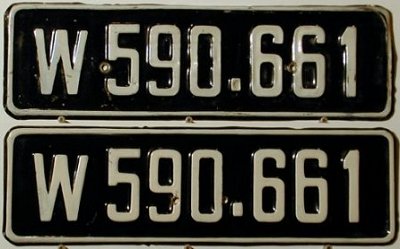 |
This pair of plates was found in a used car, whose former owner was an Israeli living in Vienna. These plates obviously represent a pre-1989 Vienna registration, but they are made with Israeli dies, and it appears they were in actual use. One can only speculate why those plates were made: Maybe the original plates were stolen on a trip to Israel, and replacements locally made. |
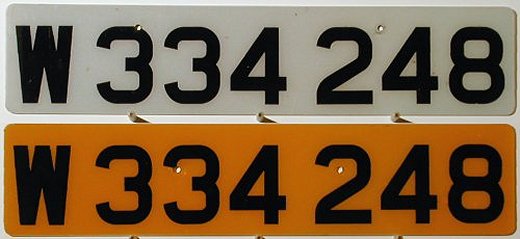 |
in 1987, while on a trip to England with my car, I had my Austrian number made up in British style, and used those plates while driving there. It made me stick out a little less. Probably this was not totally legal, but the plates were in actual use, so I deem them worthy of staying in my collection. |
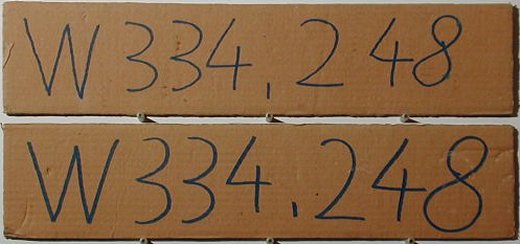 |
In 1988, while on a trip in Germany, my Austrian plates were stolen. Ironically, I was on the way to a collector's meeting, and the trunk of my car was full of plates. Good that the thief did not look into there! My first replacement plates were these pieces of cardboard with the number scribbled onto them. They are virtually worthless to any other collector, but they were in actual legal use on my car, so for me they are worth keeping. |
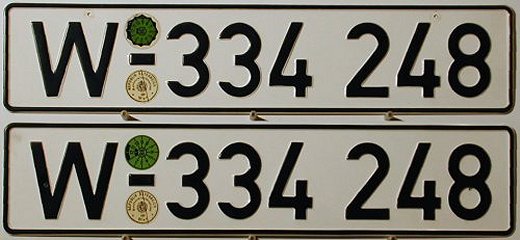 |
Then I had my number made up in local German style. These were my next replacements. At the collector meeting, TÜV and ASU stickers matching the validity of my Austrian inspection sticker (which is on the windshield) were provided by fellow collectors, and later I added the issuing authority's seal (photocopied from the registration papers, since in Austria there are no such stickers for license plates). That made them "real" German plates on an Austrian registered car. |
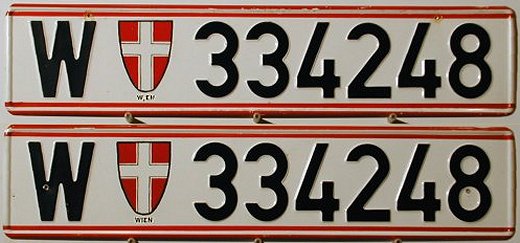 |
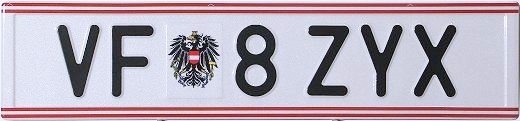
Before the white plates were introduced, I had hand-made a set of plates showing my number in the new style. This is actually a German made plate, with the red stripes and the shields hand-painted by me. After returning from Germany without plates, I also used those for a day as a legal replacement pending the issuing of a new number. |