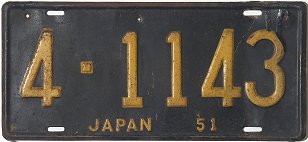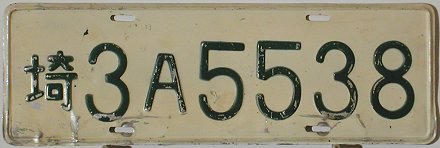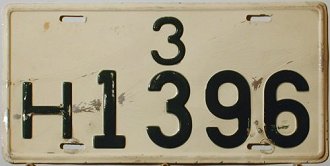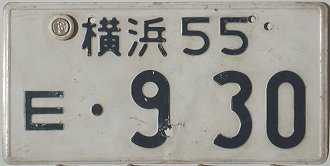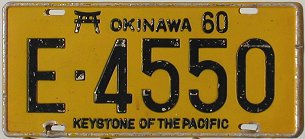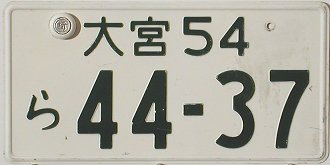
Note the seal covering the left bolt hole. This is to prevent the plate from being moved to another car, because it has to be destroyed in order to reach the bolt. For whatever reason this one escaped destruction.
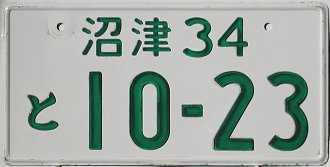
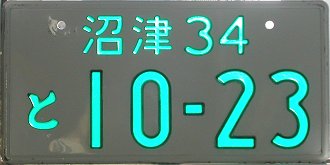
This is the much rarer illuminated plate variety, where the characters are made of translucent plastic material. The plate is shown here in normal and back-lit view. This plate type was introduced in 1973.
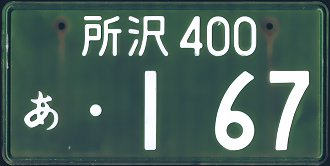
Commercial vehicles have plates in reversed colors.
On Japanese plates with less than four serial digits, there is no hyphen before the last two digits, and there is a dot in the place of missing digits.
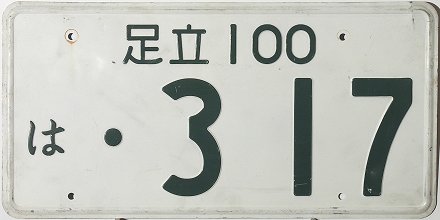
Even though heavy vehicle plates are considerably bigger than normal plates, only the big main digits are in a larger font.
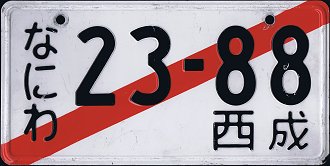
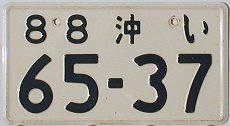
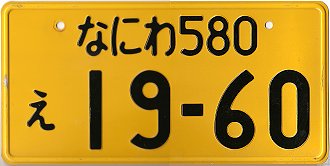
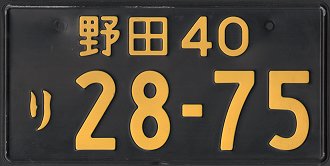
Until 1975, small cars up to 360 cc had motorcycle size plates in the normal colors of white and green. In 1975 the engine size limit was increased from 360 cc to 660 cc, and the plates became normal size, but colored yellow and black. However, the small white and green plates are still issued to small cars built before 1975.
Upper plate: 1962-1975 normal series plate. 沖 = Okinawa. 88 = car up to 360 cc.
Middle plate: 1975 onwards normal series plate. なにわ = Naniwa (Osaka). 580 = car up to 660 cc.
Lower plate: 1975 onwards commercial vehicle plate. 野田 = Noda (Chiba prefecture). 40 = truck up to 660 cc. Commercial vehicles have plates in reversed colors.
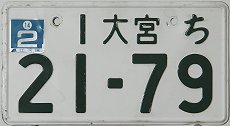
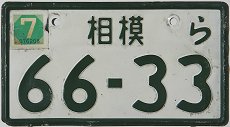
These come in two varieties for motorcycles above or below 250 cc. In the upper left corner there is an inspection sticker. Cars have that sticker on the windshield.
Upper plate: 1962 onwards motorcycle plate. 大宮 = Omiya (Saitama prefecture). 1 = motorcycle between 126-250 cc.
Lower plate: 1962 onwards motorcycle plate. 相模 = Sagami (Kanagawa prefecture). The absence of a vehicle class code and the green border indicate a motorcycle above 250 cc.
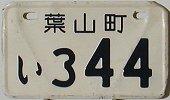
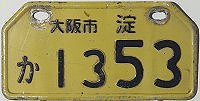
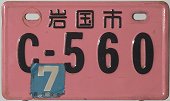
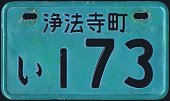
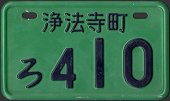
These plates are issued by municipalities rather than prefectures. The color of the plate shows the vehicle class and in the case of motorcycles also the engine size. The actual design of the plates varies by municipality. Bigger cities with longer numbers use wider plates with cut off corners.
White: Mopeds up to 50 cc. 葉山町 = Hayama town (Kanagawa prefecture).
Yellow: Motorcycles 51-90 cc. 大阪市 淀 = Osaka city, Yodogawa district.
Pink: Motorcycles 91-125 cc. 岩国市 = Iwakuni city (Yamaguchi prefecture). The sticker shows the insurance expiration.
Blue: Three wheeled vehicles and mini cars. 浄法寺町= Joboji town (Iwate prefecture)
Green: Small tractors, forklifts, snowmachines, etc. 浄法寺町= Joboji town (Iwate prefecture)